


Quick Answer
Scientists are researching this question and don’t yet have many definitive answers. What we do know is that the changes in our climate that are happening right now can amplify the effects of El Niño and La Niña events. For example, in parts of the world where an El Niño event typically leads to more rain, a hotter atmosphere is already holding more water vapor so there’s even more water available to fall. So climate change plus an El Niño event can worsen flooding.
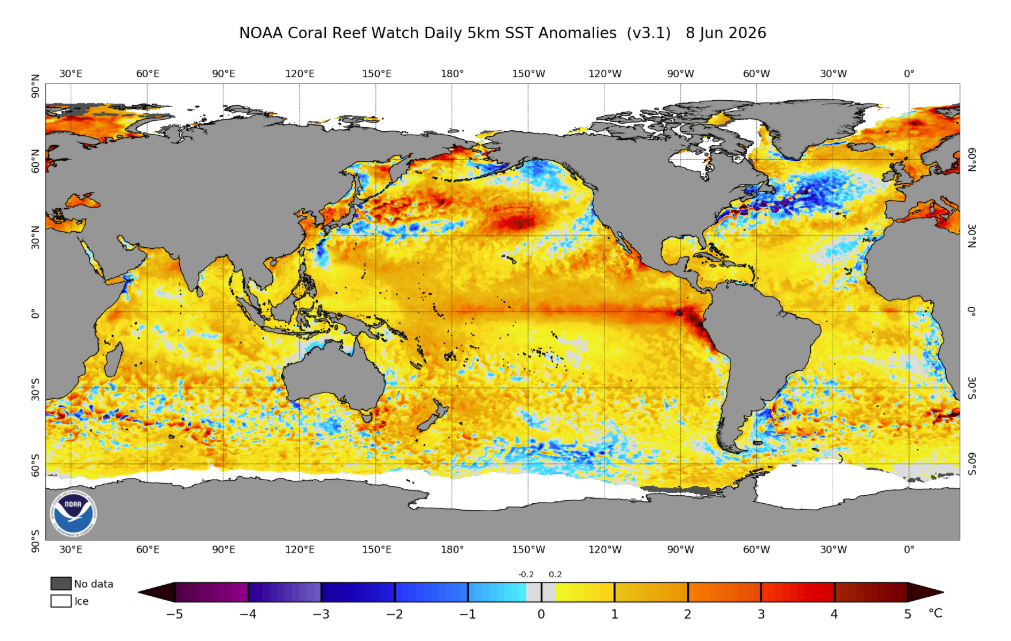
Image above: Map showing sea surface temperature anomalies (differences from the 1985-2012 average) for June 8, 2026. The anomalies in the central and eastern equatorial Pacific Ocean, with hotter than average sea surface temperatures, show an El Niño event developing. Source: https://www.ncei.noaa.gov/access/monitoring/enso/
What are El Niño and La Niña?
El Niño and La Niña are opposite phases of a natural cycle or oscillation in the surface temperature of the eastern Pacific Ocean around the equator and of the air pressure in the atmosphere above this region. During an El Niño event, the surface water of the eastern equatorial Pacific Ocean is warmer than normal, and the opposite is true during a La Niña event. This oscillation between warm and cold surface temperatures is a natural phenomenon called the El Niño-Southern Oscillation (ENSO), and each phase occurs about every two to seven years. The ENSO cycle has been occurring for at least tens of thousands of years. [1]
The ENSO cycle affects a broad swath of the equatorial Pacific Ocean, and the ocean and atmosphere interact, so it’s not surprising that El Niño and La Niña events can affect the weather across the whole planet. The figure below shows how El Niño and La Niña events typically affect winter in North America.
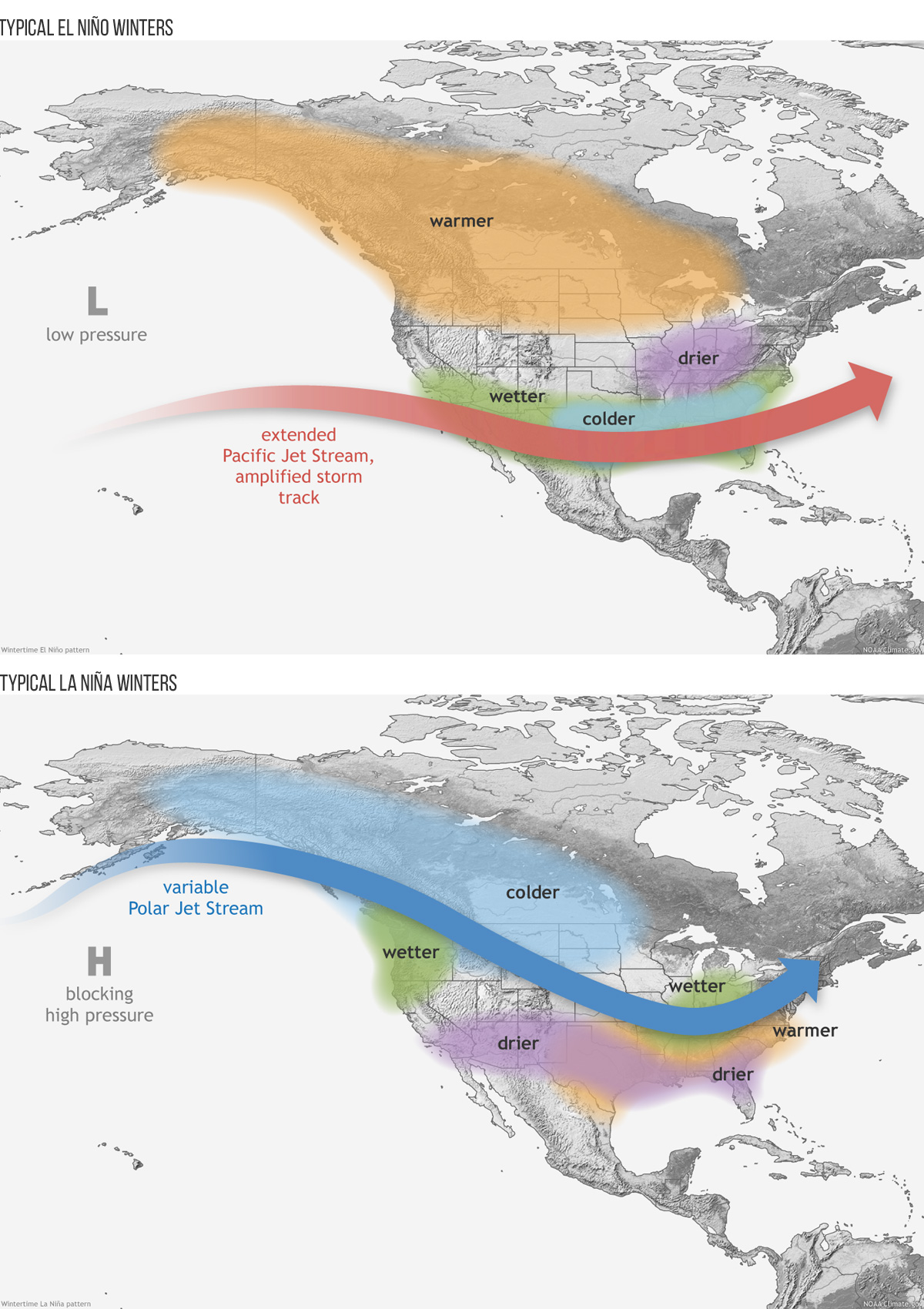
Maps: National Oceanic and Atmospheric Administration (NOAA) Climate.gov, https://www.climate.gov/media/13109, accessed June 10, 2026.
Does a changing global climate affect the ENSO cycle?
The answer to this question is the subject of active scientific research.[2,3] Some findings published between 2020 and 2026 are:
- The hot/cold sea surface temperature swings that make up the ENSO cycle have become larger due to rising concentrations of greenhouse gases in the atmosphere [4] and this trend is expected to continue as we add more greenhouse gases.[5]
- Rainfall patterns due to ENSO cycles will change: “rainfall extremes are projected to shift eastward along the equator in the Pacific Ocean during El Niño events and westward during extreme La Niña events.”[6]
- El Niño and La Niña events vary in strength, and research suggests that the strongest events are becoming more frequent.[7]
References
- Liu, Z. et al. Evolution and forcing mechanisms of El Niño over the past 21,000 years. Nature 515, 550–553 (2014). https://www.nature.com/articles/nature13963
- El Niño Southern Oscillation in a Changing Climate, Editor(s): Michael J. McPhaden, Agus Santoso, Wenju Cai. 23 October 2020 https://agupubs.onlinelibrary.wiley.com/doi/book/10.1002/9781119548164
- Alizadeh, O. A review of the El Niño-Southern Oscillation in future. Earth-Science Reviews 235, 104246 (2022). https://www.sciencedirect.com/science/article/abs/pii/S0012825222003300
- Cai, W. et al. Anthropogenic impacts on twentieth-century ENSO variability changes. Nat Rev Earth Environ 4, 407–418 (2023). https://www.nature.com/articles/s43017-023-00427-8
- Hong, S.-J., Kim, G.-I., Shin, Y., Iwakiri, T. & Kug, J.-S. Stronger ENSO-induced global SST variability in a warming climate. Nat Commun 17, 4231 (2026). https://www.nature.com/articles/s41467-026-70140-9
- Stein, T. How will climate change change El Niño and La Niña? NOAA Research https://research.noaa.gov/new-research-volume-explores-future-of-enso-under-influence-of-climate-change/ (2020); accessed June 10, 2026.
- McPhaden, M. Has climate change already affected ENSO? | NOAA Climate.gov. https://www.climate.gov/news-features/blogs/enso/has-climate-change-already-affected-enso (2023); accessed June 10, 2026.